Learning Objectives
To create a world where children everywhere are learning with understanding

Mathematics
STEM
Reading
Writing
21st century skills
Last updated: July 3, 2025
To create a world where children everywhere are learning with understanding
Widely adopted in 12 countries
5 languages
Target audience: Educators and teachers, Students, Institutional or administrative staff
Category: Assessment tool, Learning activities, Learning content and
Grade: Primary, Lower Secondary
Limited offline functionality
The information presented is provided by the company, and reviewed in good faith. Learning Cabinet is not responsible for inaccurate content.

How this product was evaluated?Ei-Mindspark aims to revolutionize education, supporting personalized learning with screening, real-life examples, feedback, and enrichment activities. Ei Mindspark Coach offers real-time support to teachers and students. Evaluations show notable gains for low-achieving students (0.37 SD in Math, 0.23 SD in Language) and a projected lifetime income increase of 5-15%, promoting socio-economic mobility and sustainable futures.
Mindspark shows a proven positive impact, backed by at least one experimental study that shows a statistically significant positive impact on the intended learning outcomes.
Different levels of research evidence indicate the reliability of the proof of positive impact. The tools featured in the Learning Cabinet range from:
An IDinsight study found Mindspark increased Math scores by 0.19–0.20 SDs over one year, with robust matching methods. Gains were significant and notably helped lower-achieving students.
Recommended use
Each learner is require to use the software between 90-120minutes per week in classroom during the academic year.
Target audience
To create a world where children everywhere are learning with understanding
EI Mindspark's curriculum is carefully crafted to align with all international curriculums and standards standards while prioritizing adaptability to local contexts. It focuses on building foundational skills in mathematics, progressing from basic to advanced topics, ensuring a gradual and structured learning path for students. The curriculum is highly adaptive, adjusting in real-time based on a learner's specific needs and pace. This enables personalized learning experiences, allowing students to receive the appropriate level of challenge or support as they move through different topics. Furthermore, Mindspark leverages data-driven insights to identify common learning gaps and misconceptions, allowing for targeted interventions and focused practice. Its curriculum design encourages conceptual understanding over rote memorization, using a blend of visual aids, engaging activities, and contextually relevant examples to deepen student comprehension.
Mindspark's pedagogy, based on constructivist and cognitive theories, uses adaptive AI to match tasks to a student’s Zone of Proximal Development (ZPD), promoting growth through slightly challenging exercises. Inspired by Bloom’s Mastery Learning, it ensures concept mastery before advancement. Regular assessments provide feedback, aligning with Hattie’s feedback research, while collaborative tasks build social skills, reflecting Bandura’s Social Learning Theory. Gamified elements enhance motivation, making learning engaging and effective.
Billed per annum per user.
Mindspark has undertaken several large-scale projects that demonstrate its impact in diverse educational settings. One notable project was conducted in partnership with the Abdul Latif Jameel Poverty Action Lab (J-PAL) across multiple Indian states, including Rajasthan and Delhi. This project used Randomized Controlled Trials (RCTs) to assess the effectiveness of Mindspark in government schools, revealing significant learning gains, especially for low-performing students. In Delhi, for example, students using Mindspark saw an average increase of 0.37 standard deviations in Math and 0.23 in Language over six months, highlighting the platform’s capacity to improve foundational skills in under-resourced settings. These findings positioned Mindspark as a highly cost-effective tool for enhancing learning outcomes, particularly in challenging. Another impactful initiative was the Quality Education India Development Impact Bond (DIB), where Mindspark was part of a collaborative effort to improve primary education outcomes across India. This project, backed by various philanthropic and governmental bodies, reached over 300,000 students, demonstrating scalable improvements in literacy and numeracy. By integrating Mindspark's adaptive learning technology into classrooms, the DIB enabled personalized learning experiences tailored to each student's pace and level, which proved especially effective in low-income schools. The evaluation showed notable gains and underscored Mindspark's potential to transform traditional teaching methods into adaptive, data-driven models that can be scaled across diverse educational contexts.

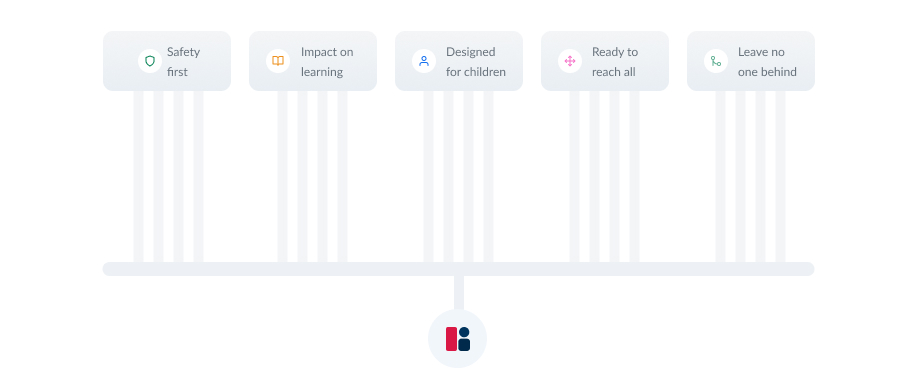
Evaluated using the Learning Cabinet’s rigorous EdTech for Good Framework to ensure safety, learning impact, scalability, and inclusion for all learners.
Read Along is a reading app that helps young learners have fun while they learn to read. Read Along has an in-app reading buddy that supports learners as they read aloud, offering assistance when they struggle, plus rewards them with stars when they do well – guiding them along as they progress.
Matific is an online maths platform helping millions of students build understanding, motivation, and confidence through hands-on gameplay. Supported by AI-powered adaptive tech, it offers teachers comprehensive controls and reports, enhancing conceptual learning for school-aged students.