Microbit logo

Micro:bit

Micro:bit

STEM

Writing

Reading

21st century skills

The BBC micro:bit is an award-winning programmable device that allows students to get hands-on with coding and digital making in a fun and accessible way. Test
website

Last updated: December 5, 2025

Overview

Learning objectives

Through the micro:bit children are encouraged to learn computing concepts and computational thinking using real code and the physical micro:bit that allows them to take abstract subject matter off the screen and into the real world. The device provides an authentic experience of the interaction between hardware and software and gives children a tool to apply practical uses of tech to their science, technology, engineering, musical, sports and art and design interests.

Evidence of impact

STRONG

Cost structure

SUBSCRIPTION

Widely adopted in 60 countries

13 languages

Target audience: Educators and teachers

Category: Skills development

Grade: Primary, Lower Secondary, Upper Secondary

Works offline but connectivity for updates required

Thumb Video 1
Microbit Photo
Microbit Photo
Microbit Photo
Microbit Photo

The information presented is provided by the company, and reviewed in good faith. Learning Cabinet is not responsible for inaccurate content.

How this product was evaluated?

Product Details

Data protection and privacy

Privacy

  • Privacy Policy icon
    Privacy PolicyOpen info in a new page
  • Terms of Service icon
    Terms of ServiceOpen info in a new page
  • Product alerts users of significant changes to the privacy policy icon
    Product alerts users of significant changes to the privacy policy

Data Sharing

  • Product does not share data with third parties icon
    Product does not share data with third parties
  • Product does not show external advertisements icon
    Product does not show external advertisements

Data Origin

  • Product utilizes AI icon
    Product utilizes AI
  • AI has been trained using product datasets icon
    AI has been trained using product datasets

Information security

  • Cybersecurity program in place icon
    Cybersecurity program in place
  • Technical best practices in place icon
    Technical best practices in place
  • No threat detection in place icon
    No threat detection in place
  • Self-assessments have been conducted icon
    Self-assessments have been conducted
  • No third party assessments conducted icon
    No third party assessments conducted

Safeguards

  • Product allows interactions between users and users can create content icon
    Product allows interactions between users and users can create content
  • Product does not use AI to generate content icon
    Product does not use AI to generate content

Hardware

  • Product includes hardware icon
    Product includes hardware
  • Product is certified by the manufacturer icon
    Product is certified by the manufacturerOpen info in a new page
  • Product complies with safety standards icon
    Product complies with safety standards
Theory

The Micro:bit's approach is grounded in constructivist learning theory, which posits that students build knowledge actively through hands-on experiences. By experimenting with code and creating projects, students construct understanding through trial, error, and iteration. This "tinkering" process aligns with constructivist principles, fostering skills like problem-solving, collaboration, and creativity, essential for 21st-century learning.

Strong evidence of impact

Impact 3/3

Micro:bit shows a proven positive impact, backed by at least one experimental study that shows a statistically significant positive impact on the intended learning outcomes.

Different levels of research evidence indicate the reliability of the proof of positive impact. The tools featured in the Learning Cabinet range from:

  • Strong: Backed by at least one experimental study that shows a statistically significant positive impact on the intended outcomes.
  • Moderate: Backed by at least one quasi-experimental study that shows a statistically significant positive impact on the intended outcomes.
  • Promising: Supported by correlational or pilot research that indicates positive or promising results on the intended outcomes.

Evidence
External Evidence
ObservationalOpen
Open link icon

The study found that 80% of students felt anyone could learn programming, 90% of teachers would reuse it, and 85% support it as a national programming tool, highlighting its positive impact on confidence and 21st-century skills.

External Evidence
Case StudiesOpen
Open link icon

Microbit found to be enjoyable and useful by pupils, enhancing programming and problem-solving skills. It also fostered teamwork to overcome challenges. Their engagement with programming grew, along with a heightened interest in STEM subjects.

Engagement
Icon representing engagement statistics

Recommended use

Primary, Lower Secondary, Upper Secondary

 The BBC Micro:bit is intended to support various lessons and outputs. The lesson plans and support materials are flexible if you have one hour to try out an activity, or embed this into curriculum across activities and lessons.  

 The BBC Micro:bit is intended to support various lessons and outputs. The lesson plans and support materials are flexible if you have one hour to try out an activity, or embed this into curriculum across activities and lessons.  

Icon representing engagement statistics

Target audience

Teachers
Wide
reach
60
Countries

Learning Objectives

Through the micro:bit children are encouraged to learn computing concepts and computational thinking using real code and the physical micro:bit that allows them to take abstract subject matter off the screen and into the real world. The device provides an authentic experience of the interaction between hardware and software and gives children a tool to apply practical uses of tech to their science, technology, engineering, musical, sports and art and design interests.

Convocation hat icon

Curriculum

  • Global curricular frameworks

Information about curriculum

Lessons are designed to align with international curriculum, with clear learning progression. Lessons are designed to allow teachers to integrate into various aspects of their curriculum and targeted at students aged 7-11, 11-14 and 14-16 years old.

Pedagogical design

The Microbit is a small computer that enables hands-on coding, fostering creativity and active learning through a constructivist approach. It teaches computational thinking via practical projects that solve real-world issues, entertain, or promote well-being. Designed for simplicity, the Microbit is widely used globally to teach computing concepts, broadening student engagement and motivation in computational learning.

  • In UK terms KS2 and KS3 are well mapped In UK terms KS2 and KS3 are well mappedIn UK terms KS2
  • KS3 are well mappedIn UK terms KS2 and KS3 are well mappedIn UK terms KS2 and

Accordion toggle
Additional Details
Flexibility
The product allows learner agency (e.g. it provides flexibility for the learner or teacher to make choices, take actions, or influence their learning outcomes and experiences).
The product supports adaptive personalized learning, including tailoring instruction and content with feedback to the unique needs, preferences, and goals of each learner
Learner engagement
The product has interactive design where a learner can interact with the content via different actions, like for example solving problems.
Creativity
The product allows content creation
The product includes problem-solving activities
Collaboration
Learner-to-learner interaction
Learner-to-instructor interaction
Instructor-parents/caregivers interaction
Learner-parents interaction


User Experience

Accordion toggle
Data-driven product development

We have a set of metrics we work with on a regular basis to understand user profiles; numbers, location and language for instance. Our Data Insights manager coordinates these analytics for use across the Foundation which is reviewed monthly or quarterly depending on the metric. The Foundation developed a theory of change related to our products and services three years ago to plot and understand how our contribution supported improved learning outcomes. In project evaluations we test the assumptions involved in the theory of change. User testing and feedback is also a core part of the feedback required to improve our tool.

  • A
  1. B
    1. A
Accordion toggle
Geographic focus
No, the product was designed for broad geographic use
Accordion toggle
Ensuring content quality
Expert Review: Content is reviewed by subject matter experts.
Educational Standards Alignment: Content aligns with educational standards.
User Feedback Incorporation: Regular updates are informed by user feedback.
Accordion toggle
Supervision and communications
This product requires supervision or specific skills
This product is primarily designed for classroom setting
The product includes communications capabilities.

Infrastructure

  • Device compatibility
    Smartphone, Feature phone, Tablet, Desktop/Laptop, Chromebooks, Accessibility reader
  • Designed for low-cost devices
    Yes
  • Environment
    Web-Based (Accessible via a web browser without requiring installation on a device), Device Installable (Requires installation on a device to be used, i.e. a mobile or desktop app)
  • Offline availability
    Works offline but connectivity for updates required
  • Integration with 3rd party
    -

Support

  • Training materials
    Video tutorials, User manuals, Interactive guides, Webinars, Online courses
  • Training material languages
    Arabic, Chinese Traditional, Croatian, English, French, Japanese, Korean, Malay, Portuguese, Serbian, Simplified Chinese, Spanish, Welsh
  • Training material target users
    Educators and teachers
  • Technical support

    Image for Technical support 1
    Email Support

Local Adaptability

  • Curriculum / educational content can be customized
    Yes
  • Visual / audiovisual content can be customized
    Yes
  • Content can be customized
    Yes
  • Current languages
    Arabic, Chinese Traditional, Croatian, English, French, Japanese, Korean, Malay, Portuguese, Serbian, Simplified Chinese, Spanish, Welsh
  • Possibility to translate the product to new language
    Yes
  • Licensing information
    • The content is open source
    • The software is open source
    • The hardware design is open source
  • Is the product a Digital Public Good (DPG)
    No

Data import/export

  • Export data capability
    CSV, JSON
  • Exportable data types
    User data
  • Import data capability
    Code for the most part.
  • Automation
    Large-scale upload at a ministry/institutional level
Affordability

Affordability Card

Business model icon
Business model
  • Business to Consumer (B2C)
  • Business to Government (B2Gov)
  • Business to Business (B2B)
Pricing model icon
Pricing model
  • One-time payment
Pricing tiers icon
Pricing tiers
  • District based
  • National
  • Per student
  • School based
Convocation hat icon

Pricing available per request

    Ask for details
    Email icon

    Pricing Strategy

    The BBC Micro:bit is intended to be a stable device for use in the classroom, we aim to keep prices as low as possible whilst providing the best learning experience. The device is not updated frequently (in terms of the hardware) to allow teachers to use the device in the long term. All content is currently free at the point of access.

    • Free
      • Freemium
    • Subscription


    1. test
      1. test 2

    Adjustable Pricing Options

    No, we would aim to make the device and content accessible to all.

    Organisation and Operations

    Organization Details

    Developed in
    United Kingdom
    Type of organization
    Non-profit, Philanthropic organization
    Stage of organization
    Growth Phase
    (since 2017)
    Number of employees
    25-50
    Developed in
    United Kingdom
    Type of organization
    Non-profit, Philanthropic organization
    Stage of organization
    Growth Phase
    (since 2017)
    Number of employees
    25-50
    Developed in
    United Kingdom
    Type of organization
    Non-profit, Philanthropic organization
    Stage of organization
    Growth Phase
    (since 2017)
    Number of employees
    25-50
    Convocation hat icon

    Experience with large projects

    • Open link iconNationwide government projects
    • Open link iconRegional or state government projects
    • Open link iconLocal government projects
    • Open link iconPartnership models with national institutions
    Case Study Link
    Open link icon

    Large implementation example

    It may be helpful to see impact projects here https://microbit.org/impact/case-studies/ In 2023 we began delivering "the next gen" a project to support access to micro:bits to all primary schools in the UK. Over 21000 primary schools in the UK (90% of primary schools) joined the programme and are working on getting started activities, learning machine learning projects and incorporating micro:bit into their curriculum.

    Accessibility of Design

    Users with disability have been taken into account in the design of the product.
    Success iconMicro:bit fulfils the WCAG 2.1 level AA requirements
    Tool tested with:
    successExpert validation (using free NVDA screen reader)
    successPerson with disability

    Equity of access & Gender

    Accordion toggle
    Product usage between genders
    By inspiring more young people to learn digital skills, we aim to diversify the students who choose STEM subjects as they progress through school and into their careers. This, in turn, grows a diverse pipeline of talent, boosting social equity and contributing to the creation of better technology. The Foundation works with partners who are targeting women and girls or targeting and supporting under represented groups.

    Get in touch with the organization

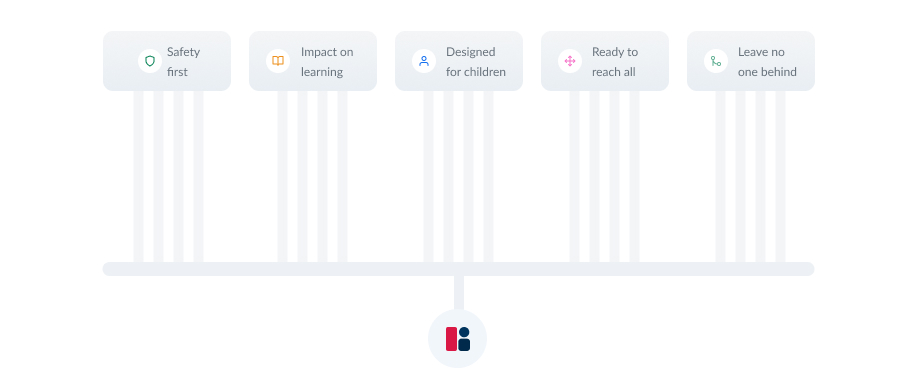
    Diagram explaining the EdTech for Good Framework

    Expert Review of Micro:bit

    Evaluated using the Learning Cabinet’s rigorous EdTech for Good Framework to ensure safety, learning impact, scalability, and inclusion for all learners.

    EdTech for Good Framework

    Compare Tools

    Micro:bit logo

    Micro:bit

    STEMWritingReading21st century skills

    The BBC micro:bit is an award-winning programmable device that allows students to get hands-on with coding and digital making in a fun and accessible way. Test

    ReadingLanguages

    Read Along is a reading app that helps young learners have fun while they learn to read. Read Along has an in-app reading buddy that supports learners as they read aloud, offering assistance when they struggle, plus rewards them with stars when they do well – guiding them along as they progress.

    Mindspark logo

    Mindspark

    MathematicsSTEMReadingWriting21st century skills

    Transforming South African Education Through Personalized, Adaptive Learning in Mathematics and English, Empowering Children to Understand and Thrive.

    Escribo logo

    Escribo

    ReadingWriting21st century skills

    Evidence-based learning games to assess and foster early learning from preschool to 2nd grade.

    1