Escribo
Escribo
Evidence-based learning games to assess and foster early learning from preschool to 2nd grade.

Literacy (Reading & Writing)
21st century skills (e.g. critical thinking, collaboration, creativity, digital skills)
Last updated: November 19, 2024
The primary learning objectives are to enhance phonological awareness, phonics, word reading, word spelling, reading fluency, and early mathematics skills such as counting orally up to 20, associating numbers with quantities, sequencing, classifying geometric shapes, numerical order, size relationships, spatial concepts, representing basic addition and subtraction.
Widely adopted in 4 countries
4 languages
Target audience: Educators and teachers, Students, Institutional or administrative staff, Parents or guardians
Grade: Early Childhood Education, Primary Education
Works offline but connectivity for updates required
The information presented is provided by the company, and reviewed in good faith. Learning Cabinet is not responsible for inaccurate content.
How this product was evaluated?Escribo Play integrates literacy and math learning theories for early childhood. Literacy combines traditional (syllable memorization), constructivist (Piaget’s stages), and phonetic (sound-letter linking) methods to build phonological awareness. Math applies Piaget’s and Vygotsky’s theories, fostering skills through exploration and collaboration. Game-based learning encourages engagement, problem-solving, and teamwork, making Escribo Play an engaging tool for foundational education.
Escribo has evidence from multiple contexts or longitudinal studies.
Different levels of research evidence indicate the reliability of the proof of positive impact. The tools featured in the Learning Cabinet range from:
Escribo’s impact on preschool literacy was studied with 749 children using phonological awareness games. Results showed 68% improvement in reading and 48% in writing over controls, showing the tool can boost early literacy in low-resource settings.
Recommended use
2 times per week, 30 minutes each time.
Target audience
The primary learning objectives are to enhance phonological awareness, phonics, word reading, word spelling, reading fluency, and early mathematics skills such as counting orally up to 20, associating numbers with quantities, sequencing, classifying geometric shapes, numerical order, size relationships, spatial concepts, representing basic addition and subtraction.
Escribo Play offers +2,000 games. Each one was created to foster a specific learning goal. These learning goals are included in state and national standards and include oral language, print, vocabulary, early mathematics and science knowledge. The games can be easily tailored to fit specific curriculum needs and can be rearranged to align with the school’s specific lesson plans.
Using this educational technology, traditional schools can incorporate games focused on syllables, rhyme, and alliteration to broaden students’ syllabic knowledge, addressing limitations of memorized syllabic families. Constructivist schools benefit through phonological awareness activities that aid developmental transitions, advancing students from pre-syllabic to syllabic-alphabetic stages. Phonics-based schools can use Escribo’s engaging activities to reduce reliance on rote memorization of sound-letter relationships, alleviating the potential stress of phonics approaches for young learners
The annual cost per student, USD 24 is much lower than that reported in 90% of studies reviewing other educational interventions (M = $4,752, SD = $9,720) (Kraft, 2020). When compared with these benchmarks (Kraft, 2020), Escribo Play positions itself as an easily scalable solution that provides medium to large learning gains.
Yes, we provide adjustable and context-dependent pricing options. The cost varies depending on the size of the implementation, its location, and any specific demands from the education department for training and implementation. For example, in rural areas where there is a lack of digital devices, paper-based alternatives may be required for the majority of students. Additionally, in larger projects, the per-user cost may be reduced due to scale gains. This flexibility ensures that our program can be tailored to meet the unique needs and circumstances of different educational environments, making it accessible and effective for all students.
We provide the technology and gamified content for Santillana Brazil (Moderna Soluções). They deployed their Aprova Brasil project to support more than 2 million first to fifth-grade students in over 2,000 Brazilian schools. We provide professional development and technical assistance for Santillana's team, which implements the textbooks and games within the state and municipal schools across all regions of Brazil. Our reading fluency module was evaluated in 2023 through a reading olympiad that had a randomized controlled design and involved 23,000 children. This project was conducted solely by our team. The evaluation revealed significant and robust gains from the fluency module. We are currently preparing scientific publications on this evaluation.

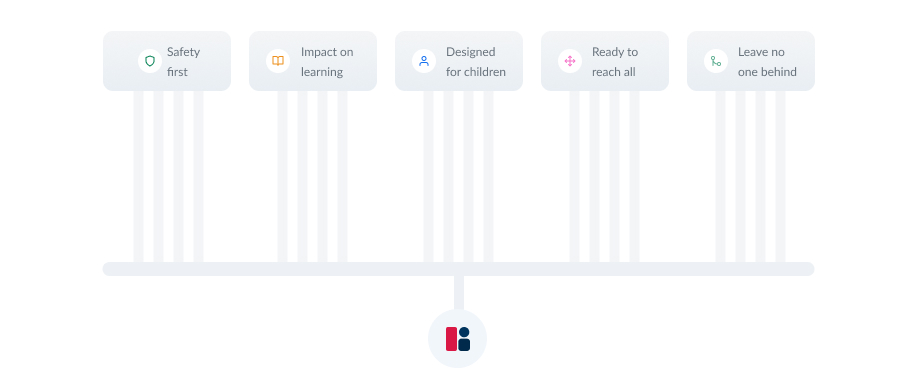
Evaluated using the Learning Cabinet’s rigorous EdTech for Good Framework to ensure safety, learning impact, scalability, and inclusion for all learners.
Escribo has been evaluated by the Learning Cabinet expert team using the EdTech for Good Framework.

Evidence-based learning games to assess and foster early learning from preschool to 2nd grade.

Matific is an online maths platform helping millions of students build understanding, motivation, and confidence through hands-on gameplay. Supported by AI-powered adaptive tech, it offers teachers comprehensive controls and reports, enhancing conceptual learning for school-aged students.

Enuma School is a personalized updated, inclusive, and tablet-based learning application designed to help children develop foundational literacy and numeracy skills at their own pace. TEST update.